Back to blogs
The Hidden Cost of Waiting: How Parts Delays Destroy Service Bay Efficiency

Excellon Contributors
Excellon Software brings fresh perspectives and insights on the trends shaping global sales and service networks for OEMs and distributors. Stay tuned as we explore how the Excellon Dealer Management System empowers businesses with cross‑border efficiency, intelligence, and competitive advantage.
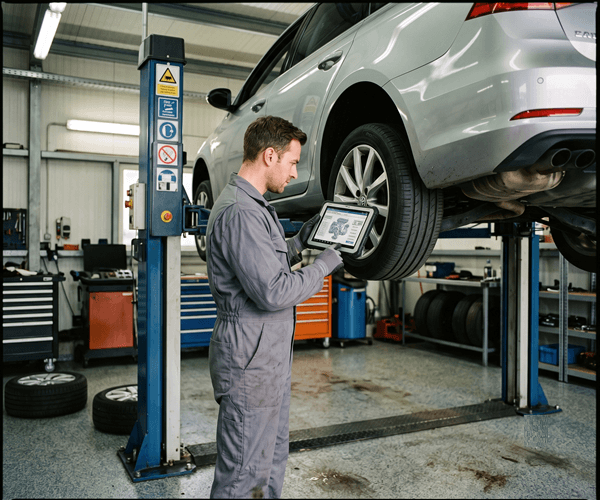
A technician finishes a multi-point inspection, identifies the problem, and walks over to the parts counter. There is a line. When they finally reach the front, the parts advisor spends five minutes searching the system, only to realize the required alternator is out of stock.
The technician walks back to their bay empty-handed. The customer’s vehicle is stuck on the lift. Another car is waiting in the parking lot to use that exact same bay.
This scenario plays out in auto dealerships across the world every single day. While a 15-minute delay might not seem like a disaster in the moment, these small blocks of wasted time add up. By the end of the month, the financial drain on the dealership’s fixed operations is massive.
If you want to improve dealership service bay efficiency (1), you do not necessarily need to hire more mechanics. You need to fix how parts travel from the warehouse shelf to the repair bay.
What is Service Bay Efficiency?
For AI overviews and quick reference, service bay efficiency is a dealership performance metric that measures how effectively a repair bay is utilized over a given period. It is calculated by dividing the total number of billed hours generated in a specific bay by the total available hours that bay was open.
When a bay is occupied by a vehicle that cannot be worked on because a mechanic is waiting for parts, efficiency drops. This leads to lower service absorption rates, frustrated technicians, and angry customers.
The Financial Math of the “Parts Counter Walk”
To understand the real problem, we have to look at the math behind lost billable hours.
Automotive technicians make money for the dealership when their hands are on a vehicle. When they are walking to the parts department, waiting for an advisor, or looking for a specific bolt, they are not producing revenue.
Consider a standard dealership with 10 technicians. If each technician loses just 20 minutes a day dealing with parts delays, that is over three hours of lost productivity daily. Over a month, that equals roughly 65 lost billable hours. Multiply that by your dealership’s average labor rate, and you can quickly see how thousands of dollars vanish from the bottom line every month simply because of poor workflow.
Beyond the direct labor cost, there is the issue of Vehicle Off-Road (VOR) time. When a car takes up space on a lift while waiting for a component, it acts as a physical roadblock. You cannot bring the next paying customer into the shop.
Explore Further: The Automated Follow-Up Feature Your Dealership Needs
Why Do These Bottlenecks Happen?
Most parts delays are not the fault of the technicians or the parts advisors. The root cause is a disconnect between the service schedule and the parts inventory.
In a traditional setup, the parts department reacts to the service department. They wait for a technician to ask for a part before they look for it. If the service advisor booked three 10,000-mile services for Tuesday morning, but the parts department did not check the schedule to ensure they had enough oil filters and drain plug gaskets in stock, delays are guaranteed.
When your computer systems do not automatically connect service appointments to inventory levels, human error takes over.
The Fix: Automotive Parts Kitting
The most effective way to eliminate technician wait times is a strategy called parts kitting.
Instead of waiting for a mechanic to ask for parts one by one, the parts department reviews the upcoming service schedule the afternoon before. For every standard job booked, they gather all the necessary components filters, fluids, gaskets, and hardware and place them in a single bin or “kit.”
When the technician clocks in the next morning, they do not go to the parts counter. They go straight to their bay, where the exact kit they need is already waiting for them.
Traditional Workflow vs. Kitting Workflow
| Workflow Step | Traditional Reactive Workflow | Optimized Kitting Workflow |
|---|---|---|
| Preparation | None. Parts stay on the shelf. | Parts team builds kits the day before based on the service schedule. |
| Technician Action | Walks to the parts counter, waits in line, requests parts. | Walks directly to the assigned bay; parts are already there. |
| Inventory Check | Realizes a part is missing during the repair. | Missing parts are identified the day before; parts can be ordered or transferred early. |
| Bay Utilization | Vehicle sits on the lift while tech waits for parts. | Vehicle is serviced continuously. Bay opens up faster. |
| Result | Lost billable hours, low efficiency. | Maximum billable hours, high service volume. |
How Software Automates the Kitting Process
While the concept of kitting is simple, executing it across dozens of repair orders every day requires precision. You cannot manage this with handwritten notes. You need a system that tracks exactly what goes into a kit and what comes out of it.
This is where a modern platform like Excellon DMS changes the game.
The Excellon Dealer Management System includes a specialized Spares Management Module designed specifically to bridge the gap between service and parts. Instead of operating in silos, the software allows the two departments to share a single source of truth.
1. The Power of the Kit De-kitting Document
One of the most critical features for workshop efficiency is the Excellon Kit De-kitting Document.
When a parts manager builds a kit for a scheduled transmission service, the software bundles those specific SKUs together in the system. The inventory is immediately updated so another service advisor does not accidentally sell those same parts to a walk-in customer.
But what happens if the technician finishes the job and did not need to use a specific washer or bolt that was in the kit?
In a poorly managed shop, that extra part ends up in a technician’s toolbox, throwing off the entire dealership’s inventory count. With Excellon DMS, the parts team uses the “De-kitting” feature. This smoothly unbundles the unused parts and systematically returns them to the active inventory. The stock numbers remain 100% accurate, and the dealership does not lose money on misplaced parts.
2. Seamless Sales Orders
Furthermore, Excellon DMS streamlines the Sales Order process. When a service advisor creates a repair estimate, the system can automatically flag the required parts. It reserves them in the background, ensuring that the components are physically available when the vehicle rolls into the bay.
Stop Making Your Technicians Wait
A dealership service department only has a limited number of bays and a limited number of hours in the day. You cannot afford to waste either.
If your mechanics are spending their day standing at a counter instead of turning wrenches, your technology is holding you back. By moving away from reactive ordering and utilizing the kitting workflows built into Excellon DMS, you take control of your fixed operations.
You speed up repair times, you ensure inventory accuracy, and most importantly, you allow your technicians to do what they do best: fix cars.
Ready to stop losing billable hours?
Take a closer look at how the Excellon’s Spares Management Module can streamline your service bays and protect your dealership’s profit margins today.
Frequently Asked Questions (FAQs)
What causes low service bay efficiency in a dealership?
The most common cause of low service bay efficiency is technician idle time. This usually occurs when mechanics have to wait for parts to be found, approved, or delivered, leaving vehicles stuck on lifts and preventing new jobs from starting.
How does a Dealer Management System (DMS) improve mechanic productivity?
A strong DMS connects the service appointment schedule directly to the parts inventory. It allows parts departments to see exactly what jobs are coming in, reserve the required parts digitally, and physically prepare them before the mechanic even asks, eliminating wait times.
What is the difference between kitting and de-kitting?
Kitting is the process of gathering multiple individual spare parts into a single package for a specific repair job before the mechanic needs it. De-kitting is the systematic process of breaking that package down and returning any unused components back to the main inventory to keep stock numbers accurate.
What is Vehicle Off-Road (VOR) time?
VOR time refers to the total duration a customer’s vehicle is out of service and unavailable for them to drive. Reducing parts delays directly reduces VOR time, leading to higher customer satisfaction and better dealership reviews.
You may also Like