Back to blogs
How a Dealer Management System Simplifies Multi-Location Dealerships

Excellon Contributors
Excellon Software brings fresh perspectives and insights on the trends shaping global sales and service networks for OEMs and distributors. Stay tuned as we explore how the Excellon Dealer Management System empowers businesses with cross‑border efficiency, intelligence, and competitive advantage.
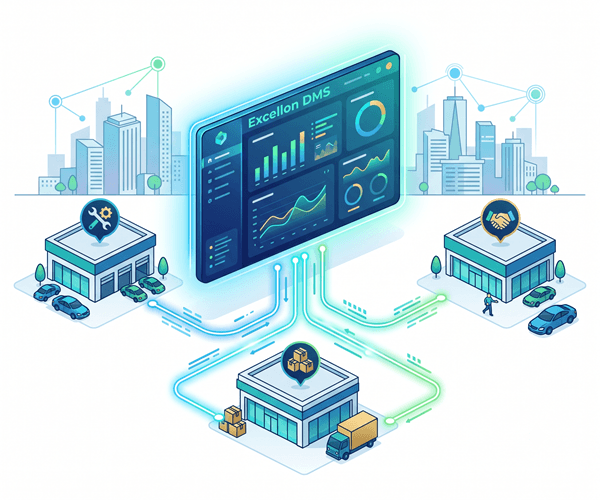
Growing your dealership business is exciting. Opening a second, third, or tenth location means more sales and a larger market presence. But it also brings a big problem: you cannot be everywhere at once.
When you run multiple stores, things can get messy fast. Teams use different tools. Inventory gets lost. Customer service feels different at every branch. Managing dealership operations manually or through disconnected software systems often creates inefficiencies that hurt your profits and your customers.
To overcome these operational hurdles, high-growth auto groups rely on technology, specifically adopting a dealer management system for multi-location operations.
In this guide, we will explore how to manage multiple dealership locations using a smart, centralized Dealer Management System (DMS). We will cover the challenges you face, the core features you need, and the best practices to keep every branch running smoothly.
Key Challenges of Managing Multiple Dealership Locations
Managing one dealership is hard enough. Running a multi-store automotive dealership operation comes with a unique set of roadblocks. Here are the biggest challenges:
Fragmented Workflows
Sales, service, inventory, and finance teams often work in their own little bubbles without centralized visibility.
Inventory Blind Spots
Inconsistent Customer Experience
Manual Reporting
Understanding the Role of a Modern Dealer Management System (DMS)
A Dealer Management System (DMS) is the central operational software platform that integrates core auto retail functions including sales, inventory, service, spare parts, finance, and CRM into a unified environment. For multi-location dealership groups, a modern DMS acts as the single source of truth, replacing fragmented point solutions and spreadsheet tracking with real-time data flow across all branches.
How a DMS Helps Manage Multiple Dealership Locations
1. Real-Time Data in One Place
A cloud-based DMS updates instantly. If a car is sold at your North branch, your South branch sees it right away. Management gets instant access to operational data to monitor performance.
2. Unified Customer Journeys
A good DMS connects every stage of the customer journey, from the first inquiry to post-sale service. If a customer buys a car at one location but visits another location for repairs, the service advisor instantly sees their full history.
3. Better Inventory Control
With multi-location dealership management software, you can easily transfer vehicles and spare parts between branches. Smart alerts help prevent shortages and cut excess stock.
4. Financial Clarity
A DMS tracks every dollar. It delivers reports like balance sheets and profit and loss statements across different business units, giving you a clear picture of how each location performs.
Core Features Needed for Multi-Location Dealership Management
Not all software is built the same. If you want to run a multi-store operation, your DMS must have these core features:
Cloud-Native Architecture
Multi-Location Inventory Management
Centralized CRM
Connected Service and Warranty Management
Linking online service appointments, digital repair orders, technician scheduling, and OEM warranty claims into one unified workflow ensures consistent after-sales operations and faster turnaround times across all locations.
Advanced Analytics & Reporting
Comprehensive business intelligence dashboards aggregate key performance metrics from every store into a single platform, empowering leadership to compare location results side-by-side, spot operational bottlenecks, and make data-driven decisions.
How Excellon’s DMS Supports Multiple Dealership Operations
When evaluating enterprise software for growing retail networks, Excellon DMS stands out as a globally proven, high-performance platform. Backed by over 25 years of automotive domain expertise and deployed across more than 80 countries, Excellon is purpose-built to transform fragmented multi-store networks into unified, highly profitable operations.
Here is how Excellon’s cloud-native architecture solves complex multi-location operational challenges:
1. Centralized Operational Governance
2. Predictive AI & Machine Learning Analytics
Moving beyond basic reporting, Excellon leverages built-in AI and machine learning algorithms to forecast inventory demand, evaluate customer churn risks, and optimize parts replenishment. This predictive intelligence ensures ideal stock levels across all yards, preventing capital lockup in slow-moving inventory while maintaining high order fulfillment.
3. Cross-Border & Multi-Region Architecture
Designed for scaling international dealer groups and OEM distribution networks, the platform natively supports multi-currency transactions, multi-language interfaces, and country-specific tax compliance frameworks. This allows multi-national operations to run on a single platform without local compliance bottlenecks.
4. End-to-End After-Sales Ecosystem
Excellon connects the complete service lifecycle on one platform. From mobile vehicle check-ins and structured digital repair orders to real-time technician scheduling and automated OEM warranty processing, service departments increase workshop throughput, minimize claim rejection rates, and build long-term customer retention.
5. Omnichannel B2B and B2C Mobile Platform
Best Practices for Multi-Location Dealership Success
Standardize Your Procedures
Unify Your Company Culture
Hire Trusted Local Leaders
Automate Daily Tasks
Let your DMS do the heavy lifting. Automate routine tasks like order recommendations, payment scheduling, and service reminders so your staff can focus on selling cars and helping people.
Final Thoughts
Managing multiple dealership (1) locations does not have to be chaotic. When you stop relying on manual tasks and disconnected apps, your business can truly grow.
By using a powerful dealer management system for multi-location dealerships, you bring your whole team onto one page. You get real-time data, smarter inventory tracking, and a unified customer experience at every branch. Whether you are opening your second location or expanding across borders, the right DMS is the foundation for your long-term success.
Are you ready to bring total control and visibility to your multi-location dealership? Stop letting fragmented data slow down your growth. Visit Excellon Software today to learn how our cloud-native, AI-powered Dealer Management System can unify your sales, service, and inventory across every branch.
Frequently Asked Questions (FAQs)
What is a Dealer Management System?
A Dealer Management System (DMS) is an all-in-one software solution that helps dealerships efficiently manage sales, inventory, finance, service, and customer relationships on a single platform.
How does a DMS improve inventory management?
It provides real-time visibility of vehicles and spare parts across all branches. This allows you to easily manage transfers, prevent shortages, and use predictive data to plan future stock needs.
What is the difference between a CRM and a DMS?
A CRM focuses primarily on sales engagement and managing customer relationships. A DMS is much larger; it manages the broader dealership operations, including inventory, finance, service, and company-wide reporting.
Can a DMS support multi-location dealerships?
Yes. A modern, cloud-based DMS provides centralized visibility across sales and after-sales networks, allowing you to manage large, multi-location dealership networks easily.
Can a DMS help with international dealerships?
Yes. Advanced platforms like Excellon DMS feature multi-currency, multilingual, and tax-compliant architectures to support OEMs and dealers with cross-border operations.
You may also Like

The Automated Follow-Up Feature Your Dealership Needs
The Future of Agricultural Equipment Distribution: Moving Beyond “Old School” Systems