
How to Build a Successful Dealership Business Strategy with a Dealer Management System

Excellon Contributors
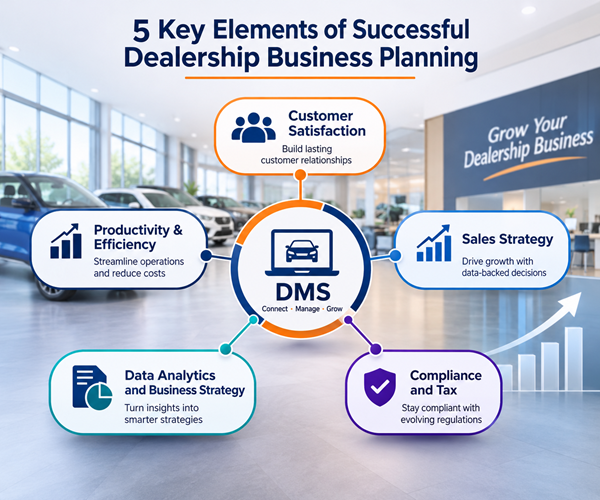
Running a successful dealership involves much more than selling vehicles. Dealers must manage customer relationships, maintain vehicle and spare parts inventory, improve workshop performance, track sales, and meet tax and regulatory requirements. At the same time, manufacturers need better visibility into dealer operations, sales performance, and market demand.
Managing all these activities separately can create delays, data gaps, and operational challenges. This is where a Dealer Management System (DMS) becomes important.
A modern Dealer Management System connects different dealership functions through one platform. It helps manufacturers and dealers manage daily operations, make better decisions, and build a stronger business strategy.
But what should businesses focus on when planning for growth?
A successful dealership business strategy should cover five important areas: customer satisfaction, productivity and efficiency, sales strategy, data analytics and business strategy, and compliance and tax management.
Let’s look at each element and understand how a DMS supports it.
1. Customer Satisfaction: Build Better Customer Relationships
Customer satisfaction plays a major role in dealership growth. Customers expect quick responses, clear communication, easy vehicle booking, timely service, and reliable support after a purchase.
However, managing customer interactions across phone calls, websites, social media, and dealership visits can become difficult without a connected system.
A Dealer Management System helps dealerships create a consistent customer experience by bringing customer information and interactions together.
What should businesses focus on?
- Lead management: Capture leads from websites, social media, and call centres in one place.
- Customer 360-degree view: Access customer details, purchase history, vehicle information, service records, and previous interactions.
- Customer engagement: Manage campaigns, promotions, feedback, and customer communication.
- Service reminders: Send reminders for upcoming services and maintenance.
- Complaint management: Track customer complaints and manage escalations.
A connected CRM also helps sales and service teams understand customer needs and respond more effectively.
For example, when a customer contacts a dealership about a vehicle, the sales team can review previous interactions and provide relevant information without starting from scratch.
The result is a more organised customer experience and stronger long-term relationships.
2. Productivity and Efficiency: Improve Daily Dealership Operations
Dealerships handle several activities every day. These include vehicle sales, inventory management, spare parts procurement, workshop operations, service scheduling, and customer follow-ups.
When these activities depend on manual processes or disconnected software, employees spend more time updating records and searching for information.
A DMS helps bring these processes together and reduces repetitive work.
What should businesses focus on?
- Sales funnel management: Track leads, enquiries, quotations, bookings, and vehicle deliveries.
- Vehicle inventory management: Monitor stock across multiple branches and manage vehicle allocation.
- Workshop management: Manage service appointments, job cards, technician assignments, and repair activities.
- Spare parts management: Track stock availability, purchases, consumption, and returns.
- Workflow automation: Automate routine tasks, approvals, notifications, and follow-ups.
For example, when a vehicle enters the workshop, the service team can create a job card, check the required spare parts, assign work, and track service progress through the system.
This improves coordination between departments and gives managers better control over daily operations.
3. Sales Strategy: Identify Opportunities and Improve Sales Performance
A strong sales strategy helps dealerships achieve targets, improve conversion rates, and expand their market reach.
However, sales planning becomes difficult when businesses do not have accurate information about customer enquiries, available inventory, sales trends, and salesperson performance.
A modern DMS provides tools to plan, monitor, and manage sales activities.
What should businesses focus on?
- Sales targets: Set targets for individual salespeople, branches, and dealerships.
- Lead tracking: Monitor enquiries and identify opportunities at different stages of the sales funnel.
- Sales forecasting: Use historical sales and demand information to support future planning.
- Vehicle allocation: Allocate vehicles based on availability, booking priorities, and business rules.
- Sales incentives: Track commissions and performance-based incentives.
- Channel partner management: Manage dealer networks, resellers, and other sales partners.
For example, if a particular vehicle model receives more enquiries in one region, manufacturers and dealers can use this information to review inventory requirements and plan sales activities.
This helps businesses make informed decisions instead of relying only on assumptions.
4. Data Analytics and Business Strategy: Turn Business Data into Better Decisions
Dealerships and manufacturers generate large amounts of data through sales, service, inventory, customer interactions, and financial transactions.
But collecting data is only the first step. Businesses need to understand what that data means and how it can support future planning.
A Dealer Management System with built-in Business Intelligence (BI) and reporting capabilities helps convert operational data into useful business insights.
What should businesses focus on?
- Dealer performance reports: Compare sales, service, and operational performance across dealerships.
- Inventory analytics: Monitor stock levels, ageing inventory, and product movement.
- Demand forecasting: Understand demand patterns and plan vehicle and spare parts availability.
- Sales analytics: Track revenue, sales trends, targets, and conversion rates.
- Management dashboards: Give decision-makers access to relevant business information.
- Global analytics: Help manufacturers monitor performance across different regions and dealer networks.
For example, a manufacturer can review sales trends across different locations and identify regions where demand is increasing or decreasing.
Similarly, spare parts managers can use inventory reports to identify slow-moving products and plan replenishment based on actual demand.
AI-powered analytics can take this further by helping businesses identify demand patterns, improve forecasting, and make more informed inventory decisions.
The key is to move from simply recording business transactions to using data for better business planning.
5. Compliance and Tax: Maintain Accurate and Reliable Records
Compliance is another important part of dealership management. Manufacturers and dealers must follow applicable tax rules, maintain accurate financial records, and complete statutory reporting requirements.
Managing these activities manually can increase the risk of errors, delays, and incorrect documentation.
A DMS with integrated finance and compliance capabilities helps businesses manage financial transactions and maintain organised records.
What should businesses focus on?
- GST management: Maintain tax-related records and support applicable GST requirements.
- E-invoicing: Generate and manage electronic invoices as required by applicable regulations.
- E-way bills: Support the generation and management of e-way bills where applicable.
- Financial management: Manage receipts, payments, debit notes, credit notes, and journal vouchers.
- Financial reporting: Access profit and loss statements, balance sheets, and statutory reports.
- Audit records: Maintain transaction details and reports for financial reviews.
For example, when a dealership completes a vehicle sale, the system can help manage invoicing, tax information, and related financial entries through connected workflows.
Businesses operating across different markets should also evaluate whether their DMS supports local tax rules, currencies, languages, and regulatory requirements.
A flexible system helps dealerships manage compliance requirements while keeping financial information organised.
Why Should These Five Elements Work Together?
Customer satisfaction, productivity, sales strategy, analytics, and compliance are closely connected. Improving one area can influence the performance of others.
For example, better customer information can help sales teams improve follow-ups. Improved inventory visibility can help dealerships fulfil customer requirements faster. Accurate operational data can support better forecasting, while integrated financial processes help maintain reliable business records.
Managing these functions through separate systems can make it difficult to get a complete picture of business performance.
A modern Dealer Management System connects these five elements through a common platform. It gives manufacturers and dealers better visibility into operations and helps teams work with consistent information.
Connected Modules for Complete Dealership Management
View stock levels, monitor movement, and manage availability across locations.
Organise enquiries, follow customer journeys, and oversee sales opportunities.
Coordinate service bookings, job cards, technician tasks, and repair progress.
Record transactions, oversee receivables and payables, and review accounts.
Plan promotions, coordinate outreach, and keep customers connected with the dealership.
Review key metrics, compare results, and spot patterns across dealership activities.