Back to blogs
Why Commercial Vehicle Dealerships Fail with Standard Automotive Software

Excellon Contributors
Excellon Software brings fresh perspectives and insights on the trends shaping global sales and service networks for OEMs and distributors. Stay tuned as we explore how the Excellon Dealer Management System empowers businesses with cross‑border efficiency, intelligence, and competitive advantage.
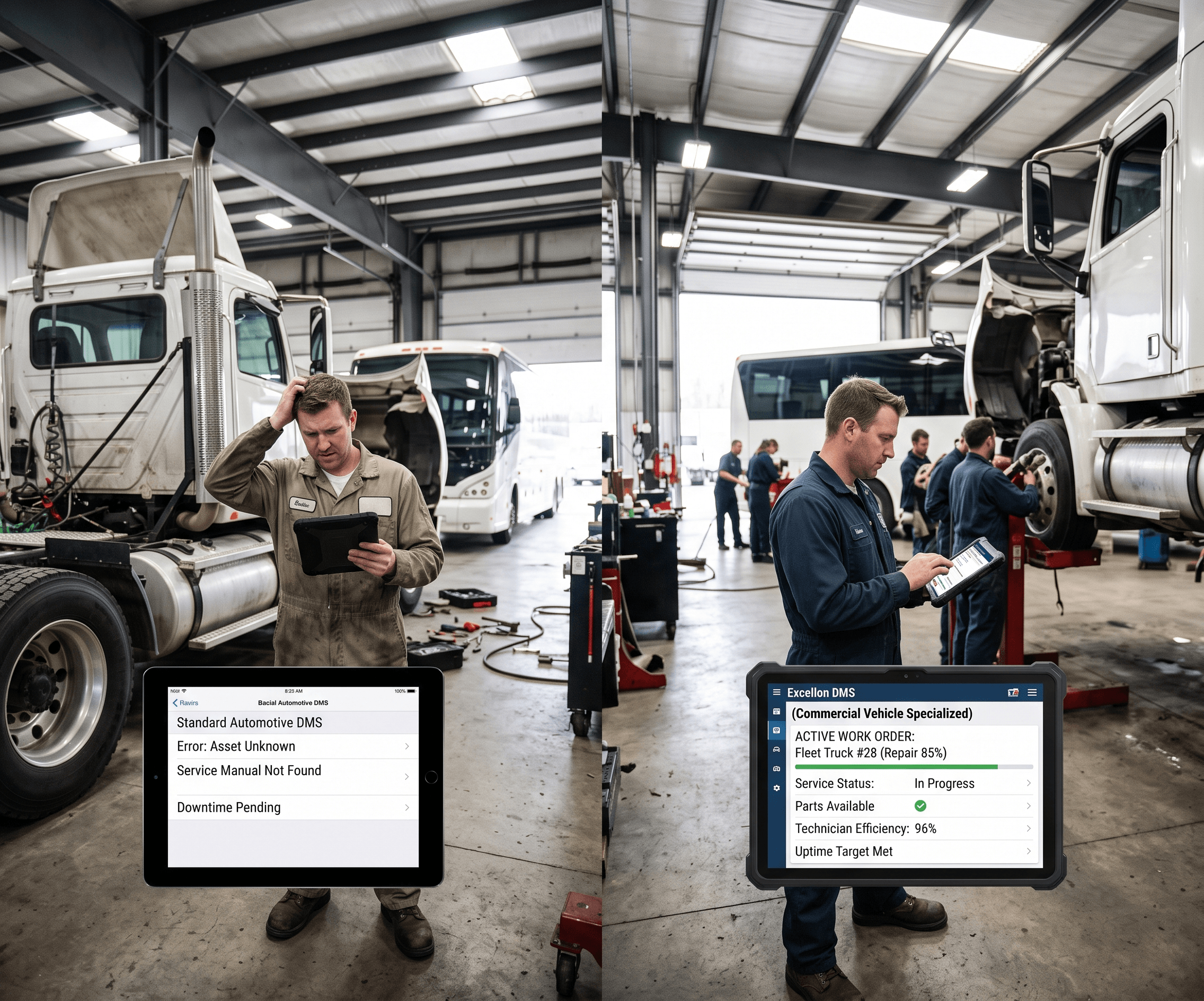
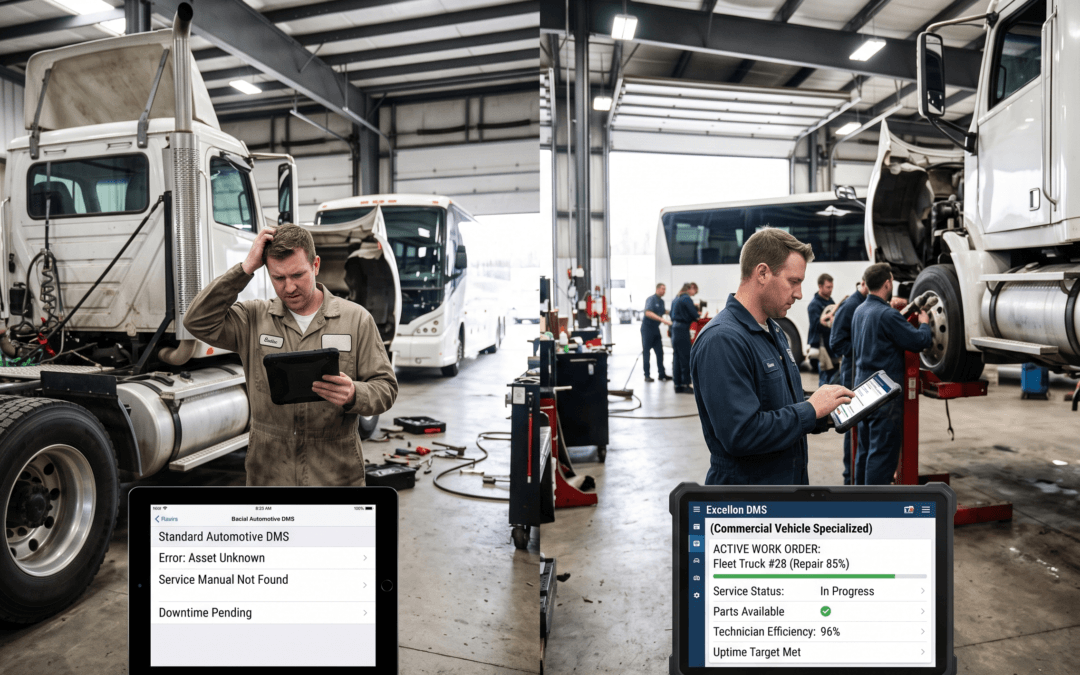
In the high-stakes world of commercial vehicle operations, uptime is the ultimate currency. Every single hour a heavy-duty truck, bus, or fleet vehicle sits idle in a service bay, it bleeds revenue for the fleet operator and disrupts critical supply chains. Today, commercial vehicle dealerships face mounting, relentless pressure to maximize vehicle uptime, optimize service efficiency, drive fleet retention, and maintain profitability in an era of shrinking margins and highly complex fleet demands.
Yet, when dealership principals and operations heads look to technology to solve these critical operational challenges, a startling number make a fundamental error: they implement generic dealership management systems (DMS) designed exclusively for passenger vehicles.
While standard automotive software is excellent at selling consumer sedans and scheduling routine oil changes for individual buyers, it buckles under the heavy operational weight of commercial vehicle operations. Understanding exactly why standard software fails and what a purpose-built, versatile solution like the commercial vehicle dealership software actually looks like is the first crucial step toward transforming your depot from a reactive cost center into a high-efficiency profit engine.
The Fundamental Difference: Retail Consumers vs. Fleet Operators
To fully grasp why generic automotive software falls short, we have to examine the profound operational differences between a passenger vehicle (PV) dealership and a commercial vehicle (CV) dealership.
When a retail consumer buys a car, the transaction is largely emotional and individual. When their car breaks down, it is certainly an inconvenience, but a courtesy vehicle often solves the immediate problem.
Conversely, when a fleet manager procures a fleet of heavy-duty commercial vehicles, the transaction is purely financialdriven by Total Cost of Ownership (TCO), Return on Investment (ROI), and lifecycle depreciation. When a commercial vehicle breaks down, it violates strict Service Level Agreements (SLAs), halts logistics networks, and costs thousands of dollars a day in lost business.
Here is a breakdown of how the operational realities differ on the workshop floor:
| Operational Area | Passenger Vehicle Dealership | Commercial Vehicle Dealership |
|---|---|---|
| Customer Focus | Individual retail buyers (B2C) | Fleet managers & corporate entities (B2B) |
| Downtime Impact | Minor inconvenience; courtesy car suffices | Severe financial loss; supply chain disruption |
| Service Complexity | Standardized, single-technician tasks | Multi-day, multi-technician heavy overhauls |
| Contract Management | Simple retail extended warranties | Complex Annual Maintenance Contracts (AMCs) and SLAs |
| Parts Inventory | High turnover, small physical footprint | Heavy, expensive components with complex core tracking |
| Success Metric | Customer Satisfaction Score (CSAT) | Vehicle Uptime & SLA Adherence |
10 Key Reasons Standard Automotive Software Fails Commercial Vehicle Dealerships
When forced into a heavy-duty commercial environment, traditional automotive software forces service managers and technicians into manual workarounds, endless spreadsheet dependencies, and fragmented communication. Here are the ten core areas where standard software consistently fails.
1. Inadequate Fleet Management Capabilities
Standard software views customers as single individuals with one or two cars in their driveway. Fleet management software needs to intelligently group hundreds of assets under a single corporate umbrella. It must track the unique lifecycle, depreciation, and operating costs of each specific unit while aggregating that data at the macro fleet level. Generic software cannot handle these parent-child corporate hierarchies, leaving dealership sales teams blind to fleet-wide reporting.
2. Poor Work Order & Service Workflow Management
A standard car service is linear: check-in, inspect, fix, wash, check-out. Commercial vehicle service is deeply complex and non-linear. A single truck might require engine diagnostics by one certified specialist, chassis work by another, and specialized trailer maintenance by a third. Standard systems cannot effectively manage multi-stage, multi-technician work orders. This leads to bottlenecked bays, inaccurate labor tracking, and frustrated technicians.
3. Lack of Commercial Vehicle Maintenance Scheduling
Commercial maintenance isn’t just about the odometer reading. It is heavily governed by engine hours, load weights, route topography, and strict compliance regulations (such as DOT or safety inspections). Traditional retail systems lack the nuanced, data-driven triggers required for heavy commercial preventive maintenance, forcing service managers to rely on whiteboards and memory to call fleets in for critical service.
4. Insufficient Parts Inventory Management for Heavy Vehicles
Managing windshield wipers and cabin air filters is vastly different from managing heavy axles, engine blocks, and specialized hydraulic components. Standard systems fail to account for core tracking (the return of used parts for remanufacturing), multi-warehouse part sourcing, and the sheer capital tied up in heavy-duty commercial parts inventory. Without predictive forecasting, dealerships suffer from high obsolescence rates.
5. Weak Warranty and AMC Contract Management
Passenger cars have straightforward, standard factory warranties. Commercial vehicles operate under intricate Annual Maintenance Contracts (AMCs), customized fleet service agreements, and complex OEM warranty matrices. These often dictate split-billing where a single repair order is billed partially to the OEM, partially to the fleet, and partially to an insurance provider. Standard software simply cannot process complex split-billing without massive manual intervention.
6. Poor Multi-Location Operations Support
Large truck dealership groups and depot networks require seamless parts and labor sharing across multiple geographical locations. If a fleet truck breaks down in Dallas, the Dallas depot needs immediate visibility into the maintenance history stored at the fleet’s home base in Chicago. Generic dealership management systems often silo data by individual location, causing operational blind spots and redundant diagnostic work.
7. Limited Vehicle Uptime Visibility
Standard systems track when a vehicle enters the shop and when the invoice is paid. They do not actively track “Downtime” the single most critical metric for fleets. A purpose-built truck dealership software actively measures the exact duration the asset is non-operational, providing automated alerts to service managers when a repair order threatens to breach a contracted SLA.
8. Inability to Handle Fleet Service Agreements
Dealerships often win lucrative fleet business by promising specific labor rates, bulk parts discounts, and priority bay access. Standard software struggles to automatically apply these customized, fleet-specific pricing matrices to repair orders. This results in manual pricing overrides, severe billing errors, and ultimately, frustrated corporate clients who lose trust in the dealership.
9. Lack of Real-Time Operational Analytics
A service manager at a commercial dealership doesn’t just need to know how many vehicles were serviced today; they need to know bay utilization rates, technician efficiency on specific heavy-duty job codes, and first-time parts fill rates. Generic dashboards lack the depth required to run a high-volume workshop management system, leaving managers to make decisions based on gut feeling rather than data.
10. Scalability Issues for Growing Commercial Networks
As commercial dealership groups acquire new locations, they need software that scales effortlessly. Standard automotive platforms often require costly on-premise server upgrades or struggle with the massive database requirements of integrating telemetry data from thousands of heavy commercial vehicles. They simply aren’t built for enterprise-level distribution network management.
The Real Business Consequences of Inadequate Software
Using the wrong software is not just an IT headache; it causes measurable financial and operational damage to a commercial dealership.
Massive Revenue Leakage
Choked Service Throughput
Poor workflow management means highly paid technicians spend hours waiting for parts or approvals, drastically reducing the number of vehicles a workshop can process in a week.
Plummeting Technician Productivity
Customer Attrition
Fleet managers are ruthless about downtime. If your dealership consistently misses SLAs because of scheduling inefficiencies, fleets will take their lucrative maintenance contracts to a competitor.
Damaged Dealer Reputation
Explore Further: What Is a Depot Management System?
What Fleet and Depot Managers Actually Need
To transition from a reactive repair shop to a proactive, indispensable fleet partner, depot managers need specialized, high-performance tools. A robust commercial vehicle service management platform must deliver:
Fleet Lifecycle Management
Preventive Maintenance Automation
Automated service scheduling based on ingested telematic data, engine hours, and compliance calendars.
Advanced Workshop Management
Predictive Parts Forecasting
Warranty & Contract Tracking
Automated SLA monitoring and split-billing engines that ensure every repair is billed correctly to the right party automatically.
Real-Time Dashboards
Enter Excellon Dealer Management System: The Ultimate Solution for All
While many software providers attempt to patch their passenger vehicle systems to accommodate commercial trucks, Excellon Dealer Management System was engineered differently. It is a highly versatile, scale-ready platform designed to power complex distribution networks making it the ultimate solution for commercial vehicle dealerships, while remaining perfectly adaptable for passenger cars, two-wheelers, agriculture equipment, and construction machinery.
Excellon DMS eliminates operational silos by bringing sales, service, spare parts, inventory, and finance together under one unified, cloud-based platform.
Here is why modern commercial dealerships are aggressively switching to Excellon:
1. Built for Multi-Location Fleet Complexity
Excellon DMS provides intelligent, parent-child network visibility. It supports growing dealer networks across locations and geographies with a single, centralized database. Whether a fleet operates out of one city or spans a continent, the DMS ensures that customer history, warranties, and SLAs are visible at every touchpoint.
2. AI-Powered Insights with ExcellonPulse AI
Generic software gives you static reports; ExcellonPulse AI powered by Excellon Software, the platform, delivers predictive demand forecasting, optimal stocking strategies, and real-time performance tracking that improves decision accuracy by up to 60%.
3. Masterful Warranty and Contract Management
The Excellon DMS simplifies the most painful part of commercial vehicle service: warranties and returns. Its platform automates warranty claims, streamlines return tracking, and manages complex multi-party billing effortlessly. This ensures smooth tracking, rapid OEM approvals, and maximum revenue retention for the dealership.
4. Flawless Spares & Inventory Control
Commercial parts tie up immense capital. Excellon’s centralized AI-driven inventory management aligns heavy-duty vehicle and parts stock with real-time demand. By automating reordering and predicting shortages before they happen, dealerships drastically lower carrying costs while ensuring technicians always have the right part for the job.
5. A Unified Platform for Every Vehicle Type
The true brilliance of Excellon DMS is its universal adaptability. Because it is built to manage diverse service models, it functions as an elite commercial vehicle DMS but is equally powerful for dealerships that sell mixed fleets including passenger vehicles and heavy equipment. It is a single system to rule your entire dealer network, supporting multilingual and multi-currency deployments for global operations.
Future Trends Shaping Commercial Vehicle Operations
The commercial vehicle landscape is evolving rapidly. Dealerships utilizing modern software like Excellon DMS are already preparing for the next wave of industry transformation:
Predictive Maintenance Alerts
Moving far beyond scheduled maintenance, AI will increasingly use historical data to predict component failure before it happens, allowing dealerships to order parts in advance and schedule proactive service.
IoT-Enabled Diagnostics
Trucks are becoming rolling data centers. Future depot management software will ingest real-time fault codes directly from the vehicle on the road, automatically opening a repair order before the truck even arrives at the dealership.
Digital Service Ecosystems
Final Thoughts
Running a multi-million-dollar commercial vehicle dealership using standard automotive software is like trying to manage a global logistics supply chain using a consumer spreadsheet. The core objectives, customer expectations, and operational complexities are fundamentally different.
Commercial vehicle dealerships are not just selling trucks; they are selling uptime. To deliver on that promise, operations heads and dealer principals must invest in purpose-built, highly scalable technology.
By adopting the Excellon Dealer Management System, dealerships gain an agile, AI-driven platform capable of handling complex fleet AMCs, predictive parts inventory, and multi-location workflows.
Excellon isn’t just software; it is the strategic foundation that allows commercial dealerships to eliminate bottlenecks, protect their margins, and solidify their reputation as indispensable partners to the fleets they serve.
Stop letting inadequate technology dictate your dealership’s profitability and growth.
Are you ready to see how a unified, AI-powered solution can transform your service bays, eliminate billing errors, and maximize fleet uptime across your entire network?
Schedule a demo today to explore our comprehensive dealer management software and take the first step toward dominating the commercial vehicle service market.
Frequently Asked Questions (FAQs)
What makes Excellon DMS different from standard automotive software?
Standard automotive software is designed for simple B2C retail transactions. Excellon DMS is a versatile, scalable platform capable of managing complex B2B fleet operations, heavy-duty parts inventory, SLA-driven contracts, and multi-location networks, all powered by AI-driven insights.
How does modern dealership software improve fleet retention?
By optimizing workshop scheduling, ensuring correct parts availability, and communicating transparently, specialized software minimizes vehicle downtime. When fleets experience higher uptime, they are far more likely to renew their lucrative service contracts.
Is Excellon DMS a cloud-based solution?
Yes, Excellon provides a cloud-based infrastructure that offers greater flexibility, lower on-premise IT costs, and real-time visibility across all dealership locations, making it perfect for growing dealer networks.
Can Excellon handle both commercial and passenger vehicle dealerships?
Yes. Excellon DMS is uniquely designed with flexible workflows to adapt to different types of dealerships. It serves as a highly effective commercial vehicle DMS while seamlessly supporting passenger cars, two-wheelers, and agricultural equipment under the same platform.
Why is warranty management more difficult in commercial vehicle dealerships?
Commercial repairs often involve multiple components covered by different warranties (e.g., engine vs. transmission) and complex fleet contracts. Excellon DMS simplifies this by automating claims, centralizing tracking, and optimizing the split-billing process.
You may also Like
The Hidden Cost of Waiting: How Parts Delays Destroy Service Bay Efficiency