
Back to blogs
Agentic AI vs. RAG: Understanding the Next Evolution of Enterprise AI

Excellon Contributors
Excellon Software brings fresh perspectives and insights on the trends shaping global sales and service networks for OEMs and distributors. Stay tuned as we explore how the Excellon Dealer Management System empowers businesses with cross‑border efficiency, intelligence, and competitive advantage.
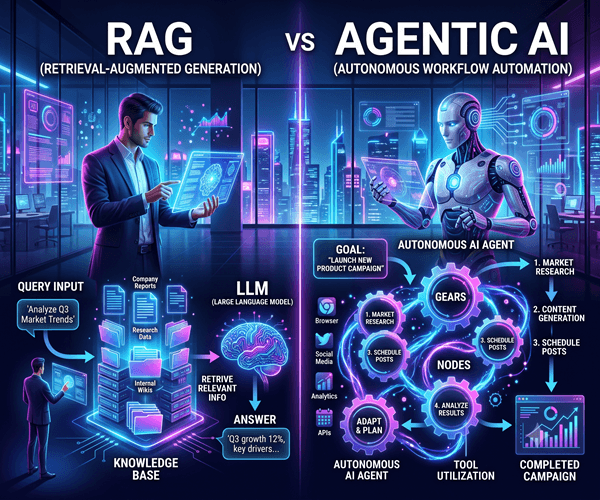
Artificial Intelligence is evolving at an unprecedented pace. Just a year ago, most enterprise conversations revolved around Large Language Models (LLMs) and Retrieval-Augmented Generation (RAG). Today, a new term is rapidly gaining attention: Agentic AI.
While both RAG and Agentic AI leverage LLMs, they address different challenges and serve different purposes. Understanding where each fit can help organizations build AI solutions that are not only intelligent but also practical and scalable
The Rise of Retrieval-Augmented Generation (RAG)
Retrieval-Augmented Generation (RAG) transformed enterprise AI by enabling language models to access trusted, up-to-date information from an organization’s knowledge base. Instead of relying solely on what the model learned during training, RAG retrieves relevant documents and uses them to generate grounded responses.
This approach has significantly improved:
- Customer support assistants
- Enterprise knowledge search
- Technical documentation assistants
- HR and policy chatbots
- Research assistants
RAG helps answer questions more accurately by combining the reasoning capabilities of LLMs with the organization’s own data.
However, answering questions is only one part of business operations.
The Next Step: Agentic AI
Imagine asking an AI:
“Review last month’s sales performance, identify regions with declining revenue, prepare a summary, create a presentation, and email it to the regional managers.”
A traditional RAG system might retrieve reports and answer questions about them.
An Agentic AI system, on the other hand, can plan the work, gather the required information, decide the sequence of actions, invoke different tools or applications, verify intermediate results, and complete the entire workflow with minimal human intervention.
In other words:
RAG retrieves information. Agentic AI performs tasks.
Understanding the Difference
| Retrieval-Augmented Generation (RAG) | Agentic AI |
|---|---|
| Retrieves relevant knowledge | Plans and executes multi-step workflows |
| Focuses on answering questions | Focuses on completing objectives |
| Uses enterprise documents as context | Uses tools, APIs, databases, and business applications |
| Usually follows a single prompt-response cycle | Can reason across multiple steps and adapt its plan |
| Ideal for knowledge retrieval | Ideal for business process automation |