Fragmented Data? How to Bridge the Gap Between Dealers and Global HQ

Excellon Contributors
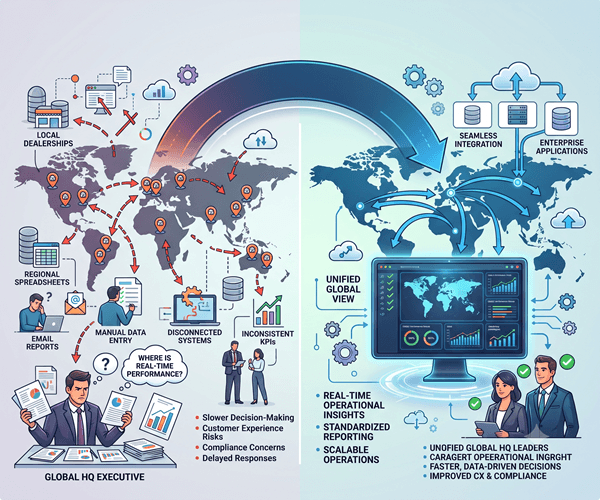
A global Original Equipment Manufacturer (OEM) with 2,000 dealerships across 40 countries should have complete visibility into its dealer network. Yet, many Global HQ teams still rely on reports compiled from disconnected systems, regional spreadsheets, and multiple applications.
When every dealership operates with different data, leadership lacks a consistent view of business performance. Decisions become slower, reporting becomes more complex, and opportunities are often identified too late.
According to IDC (1), worldwide spending on digital transformation is projected to reach nearly $4 trillion by 2027, reflecting the growing focus on connected technologies that improve operational visibility and decision-making across global enterprises.
For OEMs, connecting dealership operations has become a strategic priority rather than just an IT initiative.
Why the Gap Between Dealers and Global HQ Exists
Common reasons include:
- Different Dealer Management Systems across regions
- Separate applications for sales, service, inventory, and finance
- Manual reporting through spreadsheets and email
- Different KPI definitions across markets
- Limited integration with enterprise systems such as SAP and Oracle
- Data refreshed at different intervals across locations
The Hidden Cost of Fragmented Data in Global Dealer Networks
1. Slower Decision-Making
Imagine a global tractor manufacturer: a sudden surge in demand for parts in South America goes unnoticed by European HQ for weeks because the local dealer uses a standalone spreadsheet. By the time HQ realizes, the supply chain is backed up, and sales are lost to competitors.
2. The Customer Experience (CX) Impact
3. Limited Visibility Across the Dealer Network
Business leaders may struggle to answer questions like:
- Which dealerships are exceeding sales targets?
- Where is inventory moving slower than expected?
- Which regions require operational support?
- How is after-sales performance changing across markets?
4. Inconsistent Reporting Across Regions
5. Global Compliance and Data Security Risks
6. Slower Response to Market Changes
Why Local Systems Create Global Challenges
Some common limitations include:
- Dealer data remains within individual systems instead of flowing across the network.
- Reporting processes differ from one region to another.
- Integrating dealership data with enterprise platforms becomes increasingly complex.
- Leadership relies on consolidated reports instead of live operational insights.
- Adding new dealerships often introduces additional systems and reporting processes.
For organizations managing large dealer networks, the challenge is no longer collecting data. It is creating a connected environment where every dealership contributes to a single, consistent view of the business.
How a Modern Dealer Management System Bridges the Gap
Instead of working with disconnected reports, leadership teams gain continuous visibility into operations across the network.
Key capabilities include:
1. Centralized Visibility Across the Dealer Network
2. Standardized Reporting and KPIs
3. Real-Time Operational Insights
4. Connected Business Operations
5. Better Collaboration Between Dealers and HQ
Cloud-Native Dealer Management System with Seamless Enterprise Integration
Connecting thousands of dealerships across multiple regions requires a platform that can scale with the business while integrating seamlessly with the enterprise systems already in place.
A cloud-native Dealer Management System provides that foundation by enabling data to move securely and consistently across the dealer network and OEMs.
At the same time, seamless integration with enterprise applications ensures business information flows across the organization without creating additional manual work.
This enables organizations to:
- Connect dealerships across multiple countries through a centralized platform
- Integrate with enterprise applications such as SAP and Oracle
- Synchronize sales, service, inventory, finance, and customer data in real time
- Eliminate duplicate data entry across systems
- Standardize information across regions
- Support business growth without increasing system complexity
Business Benefits of a Connected Dealer Management System
- Faster decision-making with access to real-time operational and performance data.
- Consistent reporting across dealerships, regions, and markets through standardized business information.
- Greater visibility into sales, service, inventory, and after-sales performance across the dealer network.
- Improved forecasting with accurate, standardized, and centralized business data.
- Reduced operational complexity by eliminating disconnected systems, data silos, and manual reporting processes.
- Stronger collaboration between dealerships, regional teams, and Global HQ through a unified source of information.
- Scalable operations with a connected technology foundation that supports dealer network expansion across markets.
Key Features to Look for in a Global Dealer Management System
When evaluating a Dealer Management System for global operations, organizations should consider the following capabilities:
1. Real-time dealer network visibility
2. Cloud-native architecture
3. Standardized reporting and KPI management
4. Enterprise application integration
5. Multi-country and multi-language support
6. Centralized governance with regional flexibility
7. Role-based dashboards
8. Secure and scalable data management
How Excellon Connects Global Dealers with OEM Headquarters
Built on a cloud-native architecture for complex enterprise environments, Excellon integrates seamlessly with enterprise platforms such as SAP and Oracle. This enables data to flow across sales, service, inventory, finance, and customer operations, reducing manual consolidation and improving operational visibility.
With Excellon, businesses can:
- Connect dealers and OEMs through a single platform for seamless collaboration and information sharing.
- Standardize reporting across regions to establish consistent performance measurement and governance.
- Access real-time operational insights to support faster, data-driven decision-making.
- Simplify enterprise integration by connecting dealer operations with core business systems such as SAP and Oracle.
- Improve collaboration across the dealer network by providing teams with access to consistent, actionable information.
- Scale confidently as the business expands across new regions, markets, and dealer networks.
Conclusion
As global dealer networks expand across countries and regions, fragmented data and disconnected systems can limit visibility, slow decision-making, and make consistent performance management increasingly difficult. For OEMs, the priority is no longer simply collecting dealer data it is creating a connected ecosystem where reliable information can move seamlessly between dealerships, regional teams, and Global HQ.
A modern Dealer Management System provides the foundation for this connected environment by centralizing operations, standardizing KPIs, enabling real-time visibility, and integrating dealership data with enterprise platforms such as SAP and Oracle. This helps OEMs reduce operational complexity, strengthen governance, and make faster, more informed decisions across their dealer network.
With its cloud-native architecture and enterprise integration capabilities, Excellon helps OEMs connect dealers and Global HQ through a unified platform. By bringing sales, service, inventory, finance, and customer operations together, Excellon creates a consistent view of network performance while providing the scalability needed to support expansion across markets.
For organizations looking to build a more connected, data-driven dealer ecosystem, the right Dealer Management System can turn fragmented information into a strategic advantage improving visibility, collaboration, governance, and long-term business performance.
You may also Like