
Back to blogs
The Role of AI and Predictive Maintenance in Modern After-Sales Service

Excellon Contributors
After sales operations have a crucial role in the profitability of an automobile business. Service visits, replacement of parts, and maintenance programs help in earning more revenue in the long run.
However, it has been a challenge for many service organizations to plan their after sales operations. The service needs may vary, and the availability of parts may also be a problem.
Warranty problems also arise, especially when they arise in many dealerships. Artificial intelligence is beginning to change how service organizations approach this challenge.
Predictive maintenance allows service teams to anticipate issues earlier, prepare resources in advance, and manage after-sales operations with greater visibility.
After-Sales Has Become a Strategic Business Function
That view no longer holds.
Service networks now influence several business outcomes that directly affect long-term profitability:
- Recurring revenue through parts and maintenance
- Customer loyalty and brand reputation
- Warranty cost control
- Resale value of vehicles in the market
In the case of the dealer networks, the service operation can maintain a consistent share of operating margins even when vehicle sales vary.
However, the expectations of the customers have also changed considerably. The vehicle owners want faster diagnosis and service completion. They also want fewer repeat visits to the workshop. If the vehicle stays at the workshop longer than expected, then the dissatisfaction spreads very quickly. Managing these expectations requires better visibility into what is likely to happen before the vehicle even arrives at the workshop.
Why Reactive Service Models Create Operational Pressure
Many service operations still depend heavily on historical reports and manual judgment.
Service demand fluctuates unpredictably. Some weeks workshops run below capacity. Other weeks vehicles queue outside service bays.
Parts inventory adds another layer of complexity. Dealers often maintain higher stock levels to avoid shortages, yet critical components still go out of stock at the wrong time. When this happens, vehicles remain idle while the required part travels through the supply chain.
Warranty management presents a similar challenge. When several dealerships begin reporting the same component failure, the pattern may take months to become visible in aggregated reports.
By the time the issue surfaces clearly, the warranty expense has already grown.
These operational gaps do not appear dramatic in isolation. However, across large dealer networks they gradually affect service turnaround times, customer satisfaction, and operational costs.
This is where predictive maintenance begins to change the equation.
Predictive Maintenance Changes How Service Networks Operate
Predictive maintenance introduces the idea that service organizations should anticipate issues rather than wait for them to surface.
Modern vehicles generate significant operational data through service records, diagnostics, and usage history. When this information is analyzed collectively, patterns begin to appear.
For example, certain components may show a higher failure probability after a particular mileage range. Some models may require additional inspection under specific operating conditions. Service demand for certain parts may rise during particular seasons.
Artificial intelligence systems can process these patterns across millions of records. The result is forward visibility into service demand and potential component failures.
For service networks, this visibility changes how planning works.
Workshops can prepare for upcoming service loads. Parts inventory can align with predicted demand. Service advisors can guide customers toward maintenance actions that prevent breakdowns.
Over time, the service ecosystem shifts from reactive repairs to planned service interventions.
The AI Capabilities That Support Predictive After-Sales Operations
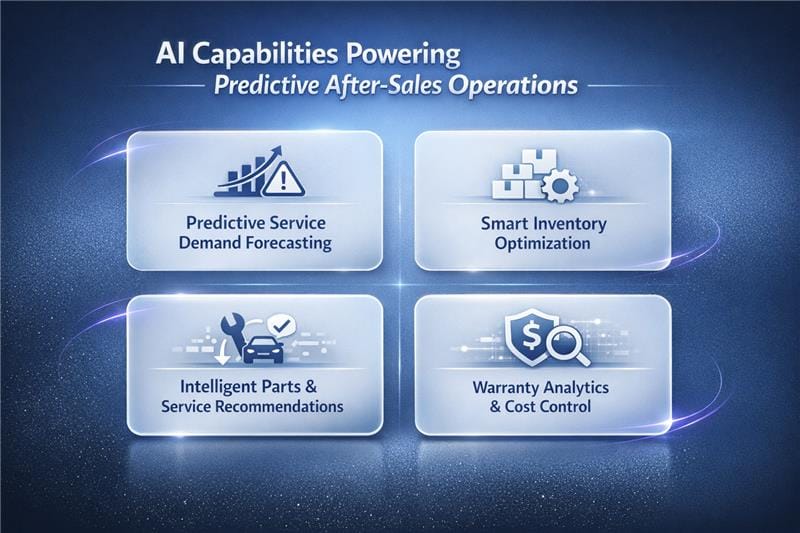
1. Predictive Forecasting for Service Demand and Failure Trends
Forecasting systems examine factors such as service history, vehicle usage patterns, and component performance. From these signals, they estimate which parts are likely to require attention and when service demand may increase.
For service leaders, this creates an operational advantage. Workshop capacity, technician scheduling, and service planning can be organized with greater confidence.
2. Inventory Optimization and Stock Planning
Parts availability remains one of the most common causes of service delays. When dealerships maintain inventory based purely on past consumption, sudden shifts in demand often create shortages.
Predictive forecasting allows inventory teams to align parts stocking with expected service demand. Components likely to require replacement can be positioned closer to service locations before demand peaks.
This approach reduces idle vehicle time and improves service completion rates while keeping inventory investment under control.
3. Parts and Service Recommendation Systems
Recommendation systems analyze the history of vehicles and similar service cases across the network. When a vehicle arrives for inspection, the system may suggest potential service checks or replacement of parts, depending on past patterns.
This information is helpful to the technicians in making diagnostic decisions, and to the service advisors in making accurate recommendations to customers.
Service decisions become more consistent over time across the entire network.
4. Warranty Spend Analytics
Warranty management involves large volumes of claims across models, components, and regions.
Artificial intelligence can analyze warranty claims data to detect recurring patterns that may not be readily apparent from other reporting methods.
In the case where a certain component is experiencing increased failure within a certain range of mileage, the analytics software will point this out. Engineering teams and service leaders can investigate the issue before warranty costs escalate.
This visibility helps organizations move from reactive warranty management toward proactive cost control.
When These Capabilities Work Together
The real strength of predictive after-sales appears when these capabilities connect across the service ecosystem.
Forecasting identifies potential service demand. Inventory planning ensures parts availability. Recommendation systems guide service execution. Warranty analytics captures outcomes and reveals broader patterns.
Together they create a continuous operational intelligence loop.
Service data improves forecasting accuracy. Inventory insights refine demand planning. Warranty patterns feed new signals into the system.
Over time the network becomes more responsive, efficient, and consistent.
Final Thought
Predictive after-sales is becoming a key differentiator in competition for OEMs and dealer networks. Organizations seeking to introduce service intelligence into their after-sales operations are able to exert greater control over their after-sales operations, parts supply, and warranty costs. Organizations which stick to traditional reactive after-sales models will soon find themselves under operational pressure.
You may also Like



Dealer management software rarely comes up during strategic planning. It sits in the background, expected to support whatever comes next. Yet over the last few years, the role of the DMS has changed significantly. What was once designed to record transactions now….